

How Much Does A Street Light Weigh?
The short answer is that a Street Light does not have one fixed weight. It depends on the wattage, housing material, heat sink size, driver structure, lens design, and the mounting system. Some smaller LED street lights can be relatively light and easy to handle during installation, while larger roadway fixtures built for wider coverage and higher output are noticeably heavier.
This is why the question matters in real projects. Buyers are usually not asking about weight out of curiosity alone. They want to know whether the fixture is easy to transport, simple to mount, suitable for the pole arm, and practical for bulk installation. For contractors, distributors, importers, and project buyers, street light weight affects far more than shipping. It also touches labor cost, bracket matching, wind-load planning, and long-term maintenance convenience.
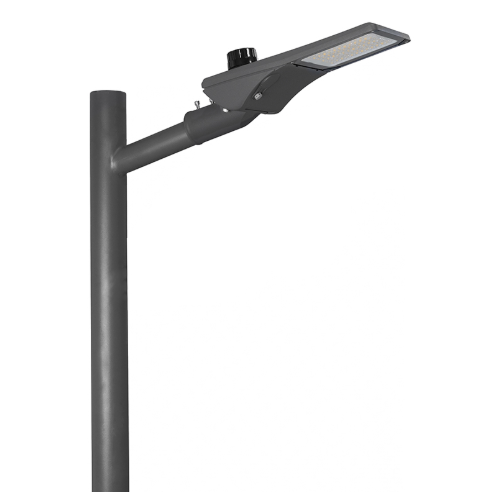
Table of Contents
Why There Is No Single Standard Weight
A street light can look similar from the outside and still differ a lot in weight. One reason is power range. A low- to mid-wattage fixture often uses a smaller housing and a simpler thermal structure, while a higher-output model usually needs more aluminum, a larger heat-dissipation body, and a stronger internal layout. Another reason is application. A fixture designed for a narrow road is often different from one used in parking lots, public roads, or municipal lighting projects.
That is why experienced buyers usually do not ask only how much a street light weighs. They also ask what that weight includes. Is it just the fixture body. Does it include the driver. Is the bracket integrated. Is the housing optimized for strength without becoming too heavy. These are much more useful questions in sourcing work.
Why Weight Matters In Procurement
In commercial lighting supply, weight has a direct effect on installation and logistics. A heavier fixture may increase freight cost, make handling more difficult on site, and require more attention during mounting. A lighter fixture may improve efficiency, but if it becomes too light because material quality is reduced, buyers may worry about durability and heat management. So the goal is not simply to find the lightest product. The goal is to find a better balance between structural strength and practical handling.
This is especially important for bulk orders. A project with dozens or hundreds of street lights turns a small weight difference into a real logistics issue. Packaging, container planning, labor time, and replacement handling all become part of the cost. That is why B-end buyers often treat weight as a practical specification, not just a technical detail.
How Product Structure Changes The Weight
Street light weight is shaped by several design choices. Die-cast aluminum is widely used because it supports durability and heat dissipation, but the amount of material used still changes from one model to another. Lens type also matters. A compact integrated structure may reduce unnecessary bulk, while a more complex body may add weight.
Our product connects naturally to this topic because it is a high-efficiency LED street light built with die-cast aluminum construction. That gives it the kind of strength and heat-control structure buyers usually expect in outdoor roadway lighting. At the same time, it is designed for practical project use across roads, parking lots, and public spaces, so the discussion about weight becomes more than a simple number. It becomes part of the fixture’s real installation value.
Why Buyers Often Ask About Weight Before Ordering
Most B-end buyers ask about weight because they are already thinking one step ahead. They are not only comparing lighting effect. They are also thinking about shipping, pole-arm compatibility, and installation pressure. A distributor may want easier stock movement. A contractor may want a fixture that crews can handle more efficiently. A municipal or engineering buyer may be thinking about mounting stability and easier maintenance later.
This is where supplier support matters. A good supplier should not answer weight questions in isolation. It should connect weight to power range, housing structure, and project use. That helps the buyer understand whether the product fits the application instead of only comparing one number across different models.
Why Efficiency And Weight Need To Be Balanced
A common sourcing mistake is to focus only on light output or only on fixture weight. In reality, those two ideas need to be balanced. A street light still needs enough structure for outdoor durability and thermal performance. If the design becomes too heavy, transport and installation become less efficient. If the design becomes too light without proper engineering, long-term performance may suffer.
Our street light is suitable for this discussion because it combines high luminous efficacy with a durable die-cast aluminum body. For wholesale customers and project buyers, that makes the product easier to position. It is not only about brightness. It is also about having a fixture that feels commercially practical across transport, mounting, and outdoor use.
What B-End Buyers Usually Care About Most
In real procurement, buyers usually care about four connected things. They want a street light that is efficient enough to stay competitive, strong enough for outdoor work, manageable enough for installation, and stable enough for repeat supply. Weight sits right in the middle of these concerns. It affects shipping cost, handling, and structural confidence all at once.
That is why a street light supplier should offer more than a catalog page. Buyers often need support on model selection, power range, installation application, and project matching. A product that is right for one road project may not be right for another, even if the wattage looks similar on paper.
Conclusion
So, how much does a street light weigh? The most accurate answer is that it varies. Street light weight depends on the fixture size, wattage, housing material, and application. Smaller LED roadway lights can be much lighter, while higher-output street lights built for wider coverage and stronger structure can weigh much more. There is no single universal number that fits every model.
For buyers, the smarter approach is to review weight together with efficiency, housing quality, and installation needs. A well-designed street light should not only deliver strong illumination. It should also be practical to ship, mount, and maintain in real projects. If you are comparing street light options for wholesale, municipal supply, or project use, contact us with your wattage, application, and installation requirements. We can help you evaluate a more suitable solution and make your sourcing decision clearer from the start.